

Why Version Control Exists: The Pendrive Problem
How Version Control Overcomes Pendrive Challenges
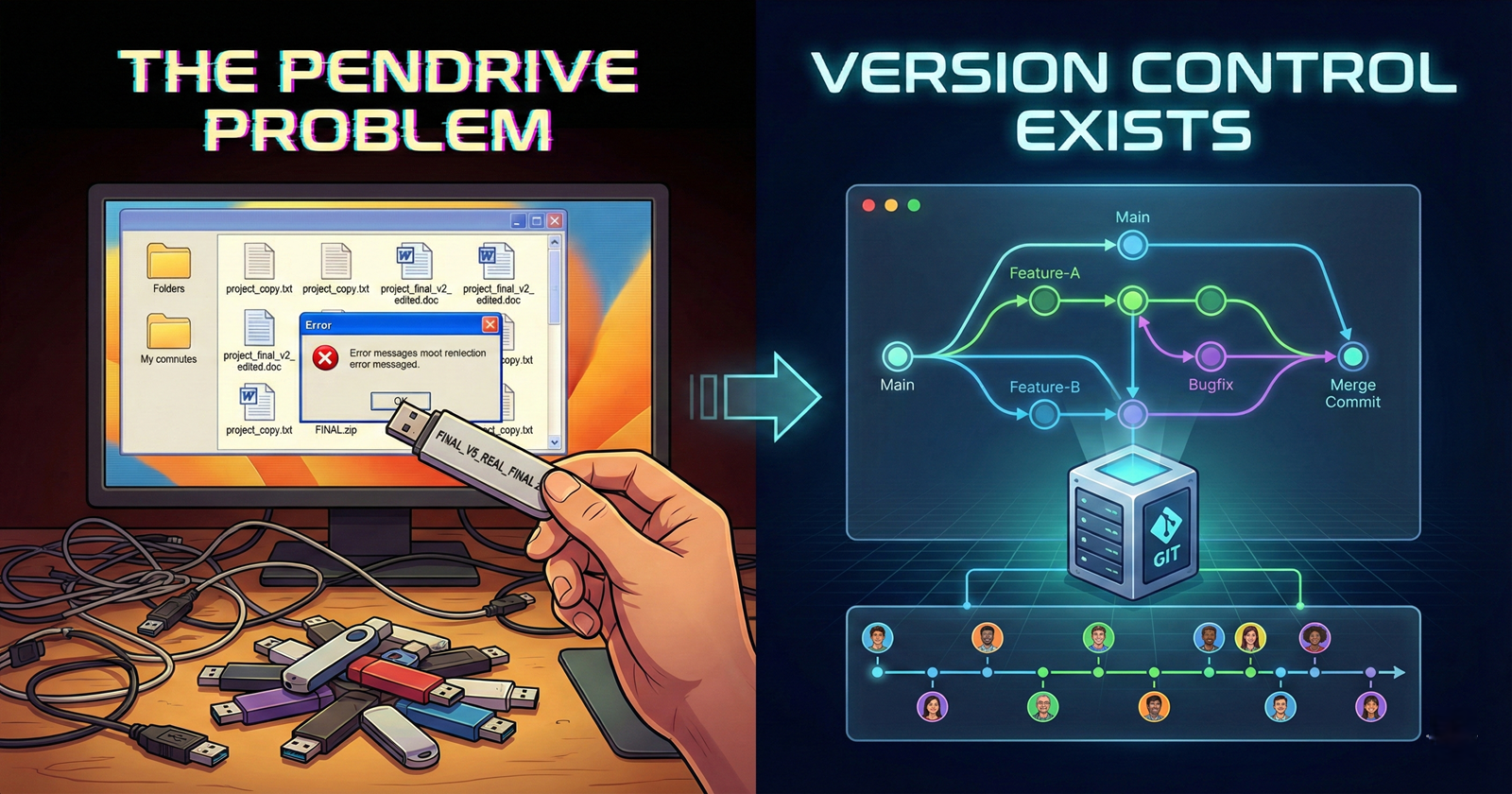
Life Before Version Control
In the early days, or in small teams even today, developers shared code using:
Pendrives
Email attachments
Shared folders (Google Drive, Dropbox)
A typical project folder looked like this:
project_final/
project_final_v2/
project_latest_final/
project_latest_final_really/
No one knew which folder was correct. No one knew what changed. And no one dared delete anything.
The Pendrive Analogy in Software Development
Imagine software development like working on a Word document with your friend — but only one pendrive exists.
Whoever has the pendrive controls the project
Others must wait
Changes are merged manually
Mistakes are common
Now let’s turn this into a story.
Santa and Banta: The Pendrive Problem
Santa and Banta were best friends who lived in two different cities. Both of them loved coding and decided to build a software project together.
They divided the work.
Santa took responsibility for Feature A, while Banta started working on Feature B.
The Old-School Way of Sharing Code
After a few days of hard work, Santa completed his part of the project. Since they lived far apart, he zipped the entire project folder, copied it to a pendrive, and sent it to Banta.
Banta plugged in the pendrive, opened the project, and got to work.
Changes Without a Trace
Banta added his own features, fixed a few bugs he noticed, and even modified some existing files to improve the code. Once he was done, he zipped the entire project again and sent it back to Santa using the same pendrive.
At first, everything seemed fine.
Confusion Strikes
When Santa opened the project, he was confused.
He could see:
New features added
Some of his old code changed
Files behaving differently
But he had no idea:
Which files were changed
How many lines were modified
Why certain changes were made
Who changed what and when
There was no history, no explanation, and no way to track changes. Santa had to manually search through the entire project to understand what had happened.
The Bug That Broke Everything
A few days later, Banta realized something terrible.
He had accidentally introduced a bug while working on Feature B.
But now:
The pendrive was with Santa
Banta didn’t have the latest version of the code
Santa didn’t even know a bug existed
They couldn’t move forward. Fixing the bug meant sending pendrives back and forth again, rechecking files, and risking even more confusion.
The project was stuck.
The Real Problem
This entire mess happened because they were sharing code using pendrives.
No version history.
No tracking.
No collaboration.
👉 This is called the Pendrive Problem.
And this is exactly why version control systems like Git exist.
Problems Faced Before Version Control Systems
1. Overwriting Code
One developer’s changes easily overwrite another’s work.
2. No Change Tracking
No way to answer:
Who changed the code?
What changed?
When was it changed?
Why was it changed?
3. No Collaboration History
There is no record of progress or decisions.
4. Manual Merging
Developers had to:
Compare files line by line
Copy-paste code
Hope nothing breaks
5. Single Point of Failure
If the pendrive is:
Lost
Corrupted
Damaged
The entire project is gone.
Why Version Control Became Mandatory
As teams grew larger and projects became complex, the pendrive approach completely failed.
Teams needed:
Parallel work
Full change history
Safe collaboration
Easy rollback
Accountability
That’s when Version Control Systems (VCS) were born.
Enter Git: The Solution to the Pendrive Problem
Git solves everything Santa and Banta struggled with:
Every developer has a full copy of the project
Changes are tracked line by line
Every change has:
Author
Timestamp
Message
Bugs can be fixed anytime
No waiting for pendrives
Now Santa and Banta can:
Work simultaneously
Share changes instantly
Track exactly what changed
Final Thoughts
The pendrive problem wasn’t just inconvenient — it was dangerous for software projects.
Version control exists because:
Humans forget
Files get overwritten
Teams need trust and transparency
Git didn’t just improve development. It saved it.


